
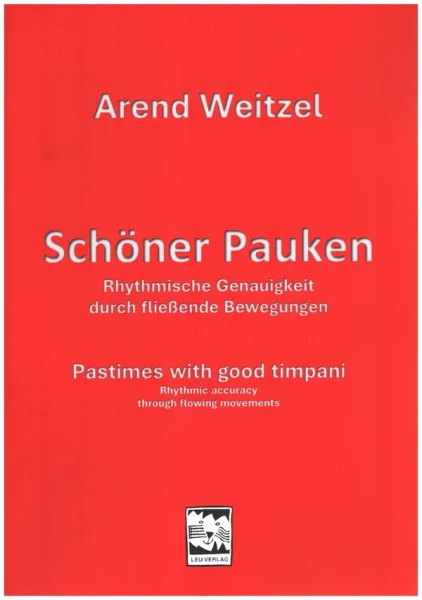
Description
Rhythmische Genauigkeit durch fließende Bewegungen
Rhythmic Accuracy through flowing Movements
Beim Pauken produzieren wir unsere Töne mit den Bewegungen der Hände und Arme.
Wenn wir rhythmische Genauigkeit anstreben, sollten wir also die Bewegungen
dementsprechend organisieren und strukturieren.
Aber was bedeutet das? Wie mussen Bewegungen beschaffen sein, damit sie
rhythmische Genauigkeit begunstigen?
Wenn sich Einzelbewegungen ununterbrochen immer gleich wiederholen, entstehen
regelmäßige bzw. zyklische Bewegungsabläufe. Weil sie wegen ihrer
Gleichförmigkeit
so berechenbar sind, eignen sich gerade Bewegungsabläufe dieser Art fur unsere
Zwecke ganz besonders.
Wir alle kennen zyklische Bewegungsabläufe beispielsweise vom Gehen, wenn wir
von A nach B gelangen wollen. Einmal in Gang gesetzt, laufen
die
Bewegungen prinzipiell nach dem immer gleichen Muster ab. Und zwar
weitestgehend
automatisch. Es ist nicht notwendig, die einzelnen Schritte jeweils gesondert
zu
beauftragen. Auch die Schrittgröße und die Schrittgeschwindigkeit ändern sich
nur
durch eine bewusste Entscheidung unsererseits. Diese Autonomie der Bewegungen
hat den Vorteil, dass wir zeitgleich andere Dinge tun können: wir können uns
nebenbei
unterhalten, mit den Händen etwas tun, etc.
Diese autonome Regelmäßigkeit ist aber keine Qualität, die nur unseren Fußen
und
Beinen vorbehalten ist. Als ehemalige Vierbeiner sind auch unsere Hände und
Arme
grundsätzlich dazu befähigt.
Wenn ich beispielsweise mit einer Hand eine fließende, kontinuierliche Folge
von
Schlägen spiele, denke ich hierbei nicht an Dinge wie Tempo, Rhythmus, Metrum
o.ä.
Unabhängig von der obligatorischen akustischen Kontrolle des Geschehens ist
es mir
ganz besonders wichtig, die Regelmäßigkeit der Bewegungen zu fuhlen, die sich
auf
verschiedene Weise bemerkbar macht:
durch die immer gleiche Bewegungsgröße
durch die immer gleiche Bewegungsgeschwindigkeit
durch die immer gleiche Aktivität der beteiligten Muskeln
durch die immer gleiche ‚Antwort‘ des schwingenden Fells
Auch hier ist es so, dass diese Schläge quasi autonom ablaufen, was mir
wiederum
die Möglichkeit eröffnet, mit der anderen Hand etwas anderes zu tun. Und das
ist gut
so, denn wir sollen ja nicht immer nur gleichbleibende Schlagfolgen pauken.
Hinsichtlich der angestrebten rhythmischen Genauigkeit besteht nun die
Herausforderung darin, auch bei komplexeren Rhythmen möglichst viel von der
Berechenbarkeit und Verlässlichkeit zyklischer Bewegungsabläufe zu bewahren.
Je
mehr sich die einzelnen Bewegungen zu einem kontinuierlichen Bewegungsfluss
verbinden, und je besser sich die Bewegungen der einzelnen Hände miteinander
verzahnen, desto ruhiger und berechenbarer werden die Bewegungen, was sich
unmittelbar auf die rhythmische Zuverlässigkeit auswirkt. Im Idealfall
entsteht hierbei
bisweilen ein Gefuhl, das manch einer vielleicht vom Jonglieren kennt: ein
lustvolles
Ineinandergreifen der Aktivitäten beider Hände, bei dem es nie zu einem
Stillstand
kommt. Dass sich das Ganze auch noch positiv auf den Klang auswirkt und ganz
nebenbei tatsächlich eine ganz eigene Ästhetik mit sich bringt, ist naturlich
sehr
willkommen.
Wie genau so etwas beim Pauken durch Koordination der beiden Hände und
behutsame Modifikation regelmäßiger Schlagabfolgen gelingen kann, wird das
Thema
der nachfolgenden Übungen sein.
Und die funktionieren folgendermaßen:
Es werden beispielhaft 13 unterschiedliche Bewegungs- bzw.
Koordinationsmodelle
behandelt. Bei jedem dieser Modelle wird zu Beginn das jeweilige Prinzip im
sogenannten Ausgangstakt vorgestellt. Hier arbeiten die Hände zunächst
synchron.
Auf diese Weise kann gut kontrolliert werden, ob die Qualität der Bewegungen
auf
beiden Seiten identisch ist. Anschließend spielen die Hände mit genau
denselben
Bewegungen zeitlich versetzt, was zu rhythmischen Veränderungen fuhrt.
Wichtig ist hierbei, dass die angegebenen Tempoangaben genau beachtet werden.
Außerdem sollten alle Übungen mit ausreichend großen Bewegungen gespielt
werden
, um die Koordinationsvorgänge gut nachvollziehbar zu
machen.
Anstelle von Handsätzen habe ich eine Notation gewählt, bei der die Noten der
einen
Hand uber der Linie, die Noten der anderen Hand unter der Linie zu finden
sind. Ich
empfehle, jedes Modell zunächst mit ein und derselben Rollenverteilung
durchzuarbeiten und danach das Ganze
mit vertauschten Rollen zu wiederholen.
Die einzelnen Übungstakte sollten außerdem auf zweierlei Art geubt werden:
Mit Wiederholungen .
Als abgesetzte Einzeltakte, um sowohl die Ausholbewegungen aus dem
Stillstand als auch den Abschluss der Bewegungen zu uben.
Hier sei darauf hingewiesen, dass nach ausnahmslos jedem Schlag der Schlägel
aktiv
aus dem Fell gefuhrt wird:
Entweder schließt sich direkt der nächste Schlag an
oder es folgt ein Zwischenschwung
oder die Bewegung des Schlägels endet nach dieser letzten Bewegung aus
dem Fell heraus. When we play timpani, we produce our sounds through the
movements of our hands
and arms. When we strive for rhythmic precision, we should therefore
accordingly
organize and give structure to these motions. But what does that mean? How can
movements be executed, in order for them to be favourable for precision?
When single movements are constantly repeated without interruption, they
develop
into regular cyclical motion sequences. And since they are so uniform and
predictable,
they are particularly suitable for our purposes.
Examples of cyclical motion sequences are familiar to us through walking,
when we
want to get from point A to point B. Once we get started, the movements
always follow
the same patterns, largely automatically. It’s not necessary to consciously
command
the individual steps. The size and speed of our steps change only through a
conscious
decision on our part. This autonomy and independence of movement has the
advantage that we can do other things simultaneously: we can chat, converse,
do
something with our hands at the same time, etc.. However, this independence of
regularity is by no means reserved just to our feet and legs. Through
evolution our hands and arms are fundamentally capable of doing
this
too.
For example, if I play a flowing continuous series of strokes with one hand,
I’m not
actually thinking about things like tempo, rhythm, meter etc. Regardless of
the
necessary acoustic control of what is happening, it is particularly important
for me to
feel the regularity of movement, which I perceive in various ways:
by the same constant size of movement
by the same constant speed of movement
by the same constant activity of the muscles involved
by the same constant answer from the vibration of the skin
Here too, these strokes become more or less independent, so in turn this
gives me the
opportunity to do something completely different with the other hand. And
that is a
good thing, because we shouldn’t be doing incessantly the exact same strokes.
With
regard to the rhythmic accuracy that we are aiming for, our challenge is now
to retain
as much of our steadiness and reliability as possible, even when playing more
complex
rhythms. The more the individual movements are combined to achieve a
continuous
flow of movement, and the better the movements of each hand interlock, the
calmer
and more predictable the movements become. Obviously this has an immediate
effect
on your rhythmic steadiness. Ideally, a feeling could arise here that some
people may
know from juggling: an automatic and perpetual interlocking of activities of
both hands,
that never seems to stop and is by the way a lot of fun! The fact that the
whole process
also has a positive effect on your sound is of course a very welcome aspect.
It also
has its own personal aesthetic!
The following exercises illustrate how exactly just a careful adjustment of
repeated
stroke sequences can succeed in coordinating your hands effectively while
playing.
And it works like this:
We have 13 examples of different movement and coordination models to deal
with.
At the beginning of each of these models an idea is presented in a reference
measure. Here your hands are simply synchronized. This way you can evaluate
your
movements effectively to assure that both sides are identical in quality.
Then your
hands carry out the exact same movements, but time-shifted, which causes
changes
in rhythm.
Here it is extremely important that the indicated tempi are strictly observed.
Furthermore all exercises should be played with rather large movements
in order to perceive and comprehend the coordination process.
Instead of using sticking indications I have chosen a means of
notation where
one hand is notated above the line and the other below the line. I recommend
working
through each model with the same assignment
and afterwards do them all over again the other way around.
Each practice measure should be practiced in two different ways:
Repeatedly as a continuous loop.
As a single measure in order to practice the preparatory up-beat movement
from the standstill and also to be aware of the conclusion of the motion.
It should be pointed out here that after every stroke without any exception
the mallet
is to be actively pulled away from the playing surface:
Either the next stroke follows directly
or there is an intermediary swing
or the movement of the mallet concludes after this last motion away from the
skin.
| Besetzung: | Pauke, Pauke solo, Schlaginstrumente, solo |
| Schwierigkeit: | 0 |
| Seitenanzahl: | 32 |
| Erscheinungsjahr: | 2022 |
Reviews
There are no reviews yet.